


Ancient Methods, Modern Results: Scribes and Scripts
In the Ancient Methods, Modern Results video series, Tim Ternes, Director of Programming for The Saint John’s Bible at the Hill Museum & Manuscript Library (HMML), invites viewers into the remarkable craft behind one of the most ambitious hand-scribed books of the modern era. In this installment, Ternes focuses on the scribes and scripts that give The Saint John’s Bible its resonance.
Click here to watch the full video on YouTube.
While the illuminations of The Saint John’s Bible often pull the most attention, Ternes reminds us that the project is, at its core, a calligraphic endeavor. Page after page of carefully written script forms the backbone of the manuscript. In contrast to the theatrical flourishes of illumination, the script itself provides humility. According to Ternes, calligraphers often describe themselves as “servants of the text,” crafting letters meant not to call attention to themselves, but to faithfully carry the Word forward.
What’s in a Script?
One of the first clarifications Ternes makes is an important one: calligraphy does not use “fonts.” Fonts belong to the world of printing. In handwritten manuscripts, the correct terms are scripts, hands, or letter forms. Drawing from Christopher Calderhead’s Illuminating the Word, Ternes explains that the scripts of The Saint John’s Bible fall into two main categories: expressive scripts and craft scripts.
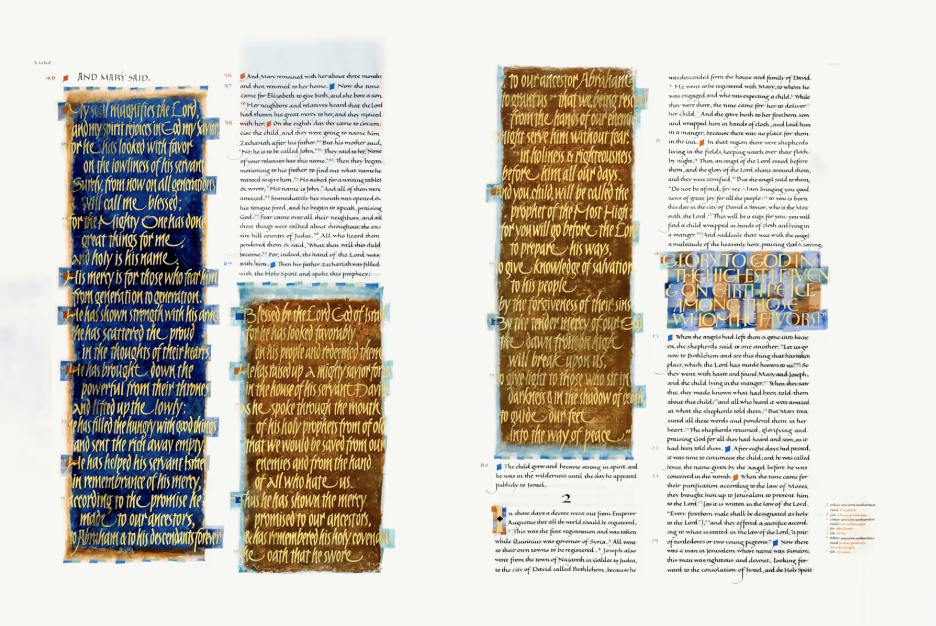
Expressive scripts allow calligraphers freedom. They are designed to highlight important passages, much like a visual highlighter. These special treatments bring attention to beloved texts such as the Magnificat, the Lord’s Prayer, the Beatitudes, and the Ten Commandments.
In this case, the letters themselves become the artwork—dancing across the page, shimmering in gold, or carved with weight and authority. Thomas Ingmire’s Ten Commandments, for example, are deliberately stenciled to appear as if cut from stone, reinforcing the gravity of the text.
Craft scripts, by contrast, are the workhorses of the manuscript. These are the scripts that carry the bulk of the biblical text. Prose is written in a justified, consistent hand that creates a stable visual grid, allowing it to stand alongside complex illuminations. Poetry appears slightly smaller and italicized, flowing more freely along the right margin. Even the smallest details—tiny handwritten footnotes addressing translation nuances—are executed with precision and care.
Three Hundred “T’s”

Throughout the manuscript, decorative scripts mark the beginnings and endings of major sections. Known as incipits and explicits, these elements echo medieval traditions while giving visual structure to the text. Donald Jackson, the project’s artistic director, designed hundreds of unique decorated capitals—no two alike—for use in the Bible. For just one volume, Jackson created more than 300 decorative capitals, including 79 different versions of the letter “T.”
Trading Hierarchy for Collaboration
While medieval scriptoria followed rigid hierarchies, The Saint John’s Bible required a new model. Jackson assembled a contemporary scriptorium—23 artists working collaboratively for nearly 15 years. Seven of them, including Jackson himself, were responsible for the primary black-letter text.
Each scribe brought a unique background and journey to the project. Some came from teaching, publishing, typography, or stone carving. Many described the challenge of mastering the quill as the most demanding aspect of the work. Yet again and again, the scribes speak of freedom, meditation, and deep personal growth that emerged from the discipline of the project.
From Scribe to Script
Despite being written by multiple hands, the text of The Saint John’s Bible maintains extraordinary consistency. Any two facing pages were always written by the same scribe, allowing subtle differences to fade from view. In a single, remarkable exception—a two-page spread in First Corinthians—all six principal scribes wrote together. Their signatures appear there, the only place in the entire Bible where the calligraphers signed their work.
As Donald Jackson famously says, every letter in The Saint John’s Bible “starts in your toes and comes out your hands.” This visible humanity is what makes the manuscript not only a work of art, but a living testament to collaboration, craftsmanship, and faith carried forward through ink and vellum.

The Saint John’s Bible: Ancient Traditions Made New
To learn more about the scribes of The Saint John’s Bible, visit the Creative Team page on www.saintjohnsbible.org.
To read more stories similar to this one, visit the Blog page and follow @saintjohnsbible on LinkedIn, Facebook, Instagram, Twitter, Bluesky, and Threads.