A Guided Analysis of The Vision of the New Jerusalem Illumination
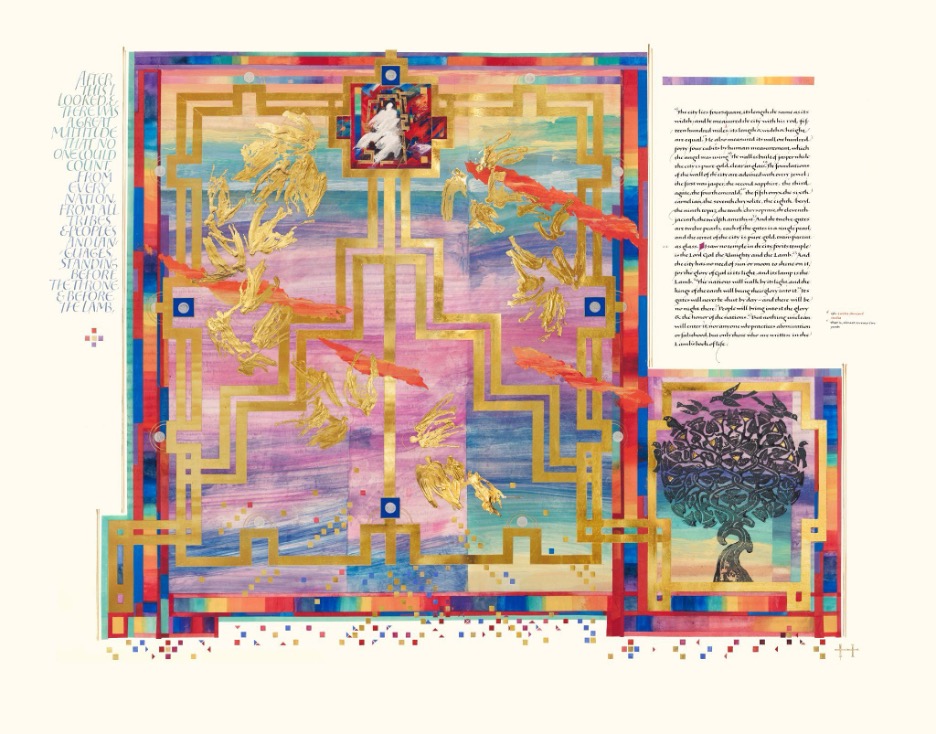
The Vision of the New Jerusalem illumination, drawn from Revelation 21 (NRSV), is one of the most theologically rich and visually expansive pages in The Saint John’s Bible. It is not merely an illustration of John’s apocalyptic vision, but a summation of the entire biblical narrative—creation, fall, redemption, and restoration—rendered in gold, color, and sacred geometry. In this illumination, all of history converges as heaven descends to earth and God’s promise is finally fulfilled.
The illumination’s themes of endings and new beginnings colliding are ones that many grapple with in the first month of a new year. So, those of us at The Saint John’s Bible Heritage Program have put together a guided analysis of this illumination for you, your peers, and loved ones to consider this January.
There are many ways to explore and interpret this illumination, and we encourage you to take the time to develop your own interpretation of the work. However, we hope this guide allows you to consider things about this illumination that you previously may not have.
Step 1: Begin at the Center — God and the Lamb
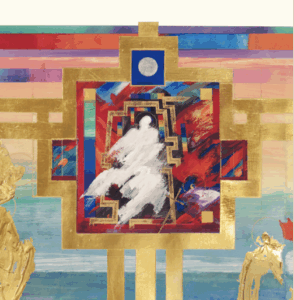 Start by looking to the top and center of the illumination, where God and the Lamb are enthroned. This placement reflects Revelation 21’s proclamation that the New Jerusalem has no temple, “for its temple is the Lord God the Almighty and the Lamb.”
As described by Saint John’s Abbey in a video reflection, God and the Lamb are seated at the very top of the illumination, establishing divine presence as the source of all meaning and order. From this throne, light and glory flow outward across the page, visually expressing the biblical claim that the Lamb is the city’s lamp (Revelation 21).
Reflection: What does it mean for divine glory—not power or wealth—to sit at the center of all things?
Step 2: Follow the Flow of Light
Allow your eyes to follow the movement of light spreading from the throne across the entire city. According to commentary from Saint John’s Abbey, this light is rendered as color, energy, and motion, intentionally filling the illumination rather than remaining contained. The visual effect reinforces Revelation’s vision of a world fully permeated by God’s glory, with no separation between sacred and ordinary space.
Reflection: Where do you notice movement or energy in the illumination? How does it shape your understanding of God’s presence?
Step 3: Observe the Open Gates
 Next, notice the four gates of the city, each depicted as a pearl. These gates are never closed. As the Dunham Bible Museum explains, the gates remain open so that all may enter—from every nation, tribe, people, and language. The Abbey reflection reiterates this inclusivity, emphasizing that the gates are open “to every language, nation, and people.” The open gates visually proclaim a theology of welcome rather than exclusion.
Reflection: What emotions do the open gates evoke for you?
Step 4: Walk the Golden Streets
Shift your focus to the streets of the city, described in Revelation as pure gold and depicted accordingly in the illumination. The Abbey commentary notes that the streets are “pure, inlaid gold,” symbolizing holiness and divine presence. Indeed, the presence of gold throughout The Saint John’s Bible is meant to signify God.
Reflection: How does this vision of a divine city differ from worldly definitions of success or power? How is it similar or different from your interpretation of what a divine land might look, or be like?
Step 5: Encounter the Tree of Life
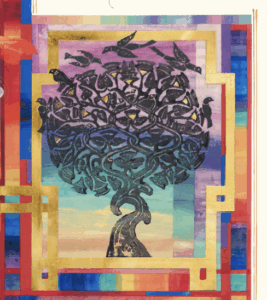 To the right of the illumination stands the Tree of Life, a reference to Genesis Chapter II. Both the Dunham Bible Museum and Saint John’s Abbey highlight this deliberate connection between the beginning and the end of Scripture. A river runs through the city, nourishing the tree whose leaves are said to heal the nations. The image declares that what was lost in Eden is restored in the New Jerusalem.
Reflection: What does healing look like—personally, communally, or globally—in this restored creation?
Step 6: Notice the Foundations
At the bottom of the page, small geometric shapes—triangles and squares—reference the precious stones described in Revelation as forming the city’s foundations. The Abbey reflection identifies these shapes as a nod to the gemstones embedded in the New Jerusalem, which ground the heavenly vision.
Reflection: What foundations support your own life or faith?
Step 7: See the Rainbow of Promise
Take in the full color palette of the illumination, which forms a radiant rainbow. According to Saint John’s Abbey, this rainbow recalls God’s covenant with Noah after the flood—a sign throughout Scripture of God’s irrevocable promise. In the New Jerusalem, that promise reaches its fulfillment as creation is fully redeemed.
Reflection: Where do you see signs of promise or hope in your own life?
Step 8: Carry the Question Forward
One could say that the Vision of the New Jerusalem does not confine glory to a distant future. Instead, it invites viewers to recognize signs of restoration, healing, and divine presence in the world today.
Final Reflection: How has your time with this illumination influenced the way you read or interpret this passage?
Bonus: The Crosses
At the very bottom of the illumination are two crosses, a detail that Father Bob Koopman, OSB, and Father John Klassen, OSB, burnished onto the page to mark the occasion of receiving this final volume of The Saint John’s Bible.
Further Reading
Calderhead, Christopher. (2015). The Making of The Saint John’s Bible, Second Edition. Collegeville, MN: Liturgical Press.
Dunham Bible Museum, Vision of the New Jerusalem
Saint John’s Abbey blog, The New Jerusalem; Revelation 21
Sink, Susan. (2013). The art of The Saint John’s Bible: The complete reader’s guide. Collegeville, MN: Liturgical Press.
To read more stories similar to this one, visit the Blog page and follow @saintjohnsbible on LinkedIn, Facebook, Instagram, Twitter, Bluesky, and Threads.