Fr. Eric Hollas’ Journey Home to Sacred Art Through The Saint John’s Bible
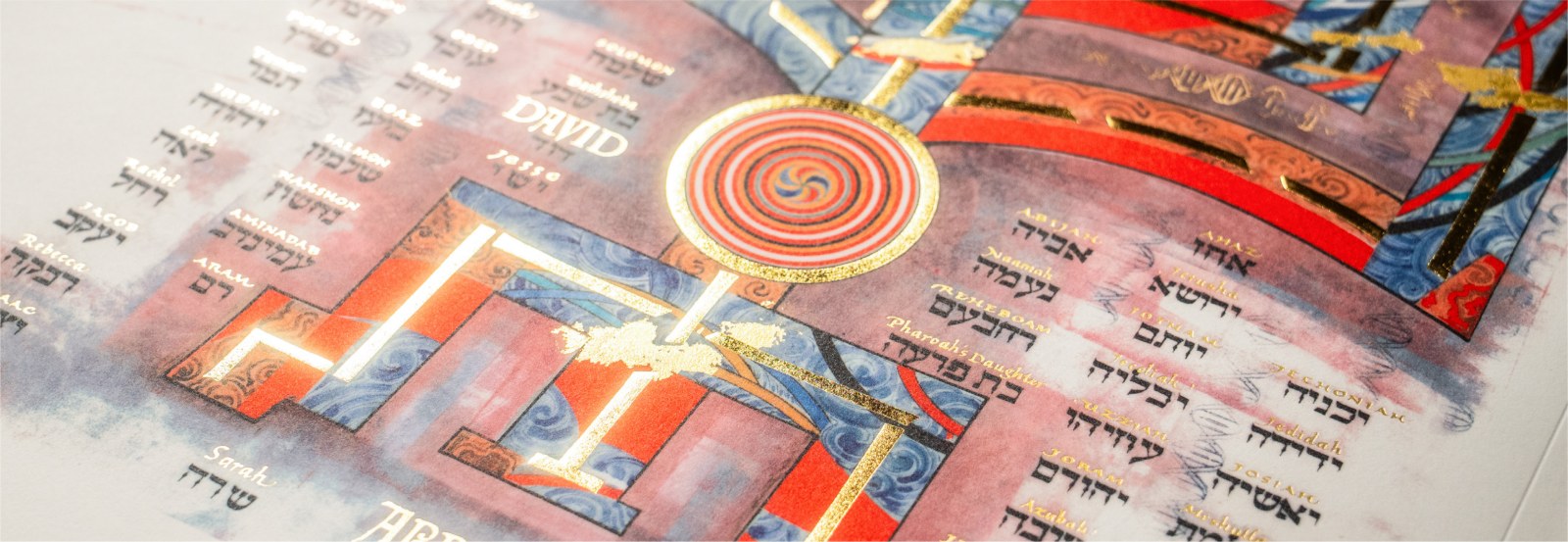
On a late autumn afternoon in 1995, former official scribe to the Crown Office and the House of Lords, Donald Jackson, approached Fr. Eric Hollas, OSB of Saint John’s University, proposing the University and Abbey commission the artist to hand-scribe and illuminate the Bible. Understandably, Fr. Hollas left the meeting uncertain.
The endeavor felt monumentally overwhelming, and questions filled Hollas’s consciousness for months. Hand-scribing the Bible hadn’t been done in 500 years. It must be for a reason. In the age of printing, why would anyone attempt to hand-scribe one of the most significant religious texts of all time?
But Hollas had given Jackson his word that he would bring it to his colleagues at Saint John’s Abbey and University. So, he did. The first set of ears was Br. Dietrich Reinhart’s, then-President of Saint John’s University. Hollas approached the subject with hesitancy, understanding that he was proposing multiple years of work that would require a large sum of funding to even begin planning. To Hollas’ surprise, Reinhart’s “yes” was immediate.
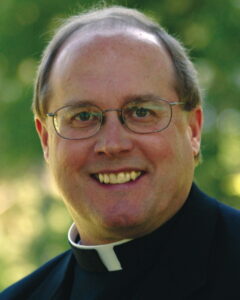 With approval from the President of the University, the responsibility fell on Hollas to initiate the project. Later, on Ash Wednesday of the year 2000, Donald Jackson wrote the first words of The Saint John’s Bible: “In the beginning…”.
“It wouldn’t be overstated to say that The Saint John’s Bible might never have happened without the thoughtful guidance and leadership of Fr. Eric.” says the Executive Director of The Saint John’s Bible Heritage Program, Rev. Dr. John F. Ross. “He had the relationships, the experience, the knowledge, and most importantly, the courage to bring this artistic endeavor to fruition.”
From the beginning, the artists and scholars of The Saint John’s Bible decided they were not going to make a Romanesque or a Gothic Bible. “We made plenty of those already,” said Hollas. “We can’t improve on those, and it would look silly to try.”
Instead, they set out to create a 21st Century Bible that illuminates the Word of God using an entirely new set of modern human experiences.
With the ball rolling and draft illuminations by the foremost calligrapher of our time awaiting him on his desk, Hollas felt his investment in the project grow beyond duty. It transformed into something deeper.
“As Donald began to complete some of these illuminations,” said Hollas, “I began to realize what this could accomplish.”
Hollas distinctly remembers the first time he saw Jackson’s illumination, Wisdom Woman. He recalls the layers of meaning settling into his brain and reigniting dormant curiosities about sacred art. Hollas, who has a Ph.D. in medieval studies from Yale University, first became fascinated with sacred art while pursuing his degree. A class called The History of Christian Art awoke him to its importance.
“As I became more entangled in The Saint John’s Bible, I began to recall some of the thoughts I had, taking that course many years earlier, and realizing the profound truth that art is capable of communicating and creating in people,” said Hollas. “Then, that realization morphed into an understanding that every generation has to try to communicate the sacred in art.”
The inclusion of the lunar cycle, a nod to the Jewish Calendar, caught his eye first. Then, the deep wrinkles on the face of Wisdom Woman. Piece by piece, the story came together.
“It struck me that this illumination acts as a kind of prophetic counter to contemporary attitudes about life, and in particular, contemporary attitudes about women,” said Hollas. “The portrait of the Wisdom Woman suggests that beauty is not on the surface. The jewelry is the lines in her face that come from a lifetime of service. Women and men have beauty that’s not dependent on their economic value, but rather on their humanity and being created in the image of God. I believe that’s a prophetic voice that needs to be heard today.”
With that, Hollas’ emotional investment in the project sparked alive. But it wasn’t until he saw how the Bible existed in the world that the importance of The Saint John’s Bible truly dawned on him.
The Saint John’s Bible Enters the World
Early in the project’s creation, Hollas and others at Saint John’s University put together an exercise for school-aged children to engage with The Saint John’s Bible. One early iteration of this engagement programming (that still exists today) involved giving children the chance to create their own illuminations based on a passage of Scripture.
This programming took place in cities across the United States. From Minnesota to New York City, Hollas and others naturally began to compare the illuminations that students across the country completed.
“When I saw the kids do this exercise, that’s when I realized that The Saint John’s Bible had great potential,” said Hollas. “Students were working on the same passage, but their illustrations were so different from each other, because their experience of life was so different. Yet, it meant something to each of them, regardless of where they were from.”
“Gradually, I came to realize that this work touched more on the meaning of life. It reminded me that art matters,” said Hollas. “In our utilitarian age, we have to reiterate that we’re not just economic beings whose sole purpose in life is to contribute to the gross domestic product. There’s got to be more to life than the economy. That’s where art comes in.”
The Written Word, Spoken
Now that the project’s creation is complete, Hollas’s work hasn’t ceased. In fact, he’s spoken all over the world about The Saint John’s Bible. Carson Newman University in Tennessee and Brigham Young University are just two of the many institutions that have been blessed with his words and insights.
At this point, Hollas is so familiar with the presentation that he forgoes notes. Still, Hollas says every presentation is different, simply because each audience brings something new to the conversation.

“Another part of my gradual evolution of appreciation for this work was to see the reaction of some people to the illuminations,” said Hollas. “I’ve seen people with tears in their eyes. How could I not be touched by that?”
For Hollas, it’s all in service to his vocation. As a Professor and Deputy to the President for Advancement at Saint John’s University, Prior of Saint John’s Abbey, a chaplain in the American Association as well as in the Subpriory of Our Lady of Lourdes of the Order of Malta, Hollas has found a way for each of his diverse titles to allow him to make a difference.
“Making a difference in life is the ultimate achievement,” said Hollas. “That’s part of what I’ve achieved as a teacher, opening possibilities to students who may have never thought they could achieve what they have. Anytime you can help someone find their vocation, you’ve made a contribution to life.”
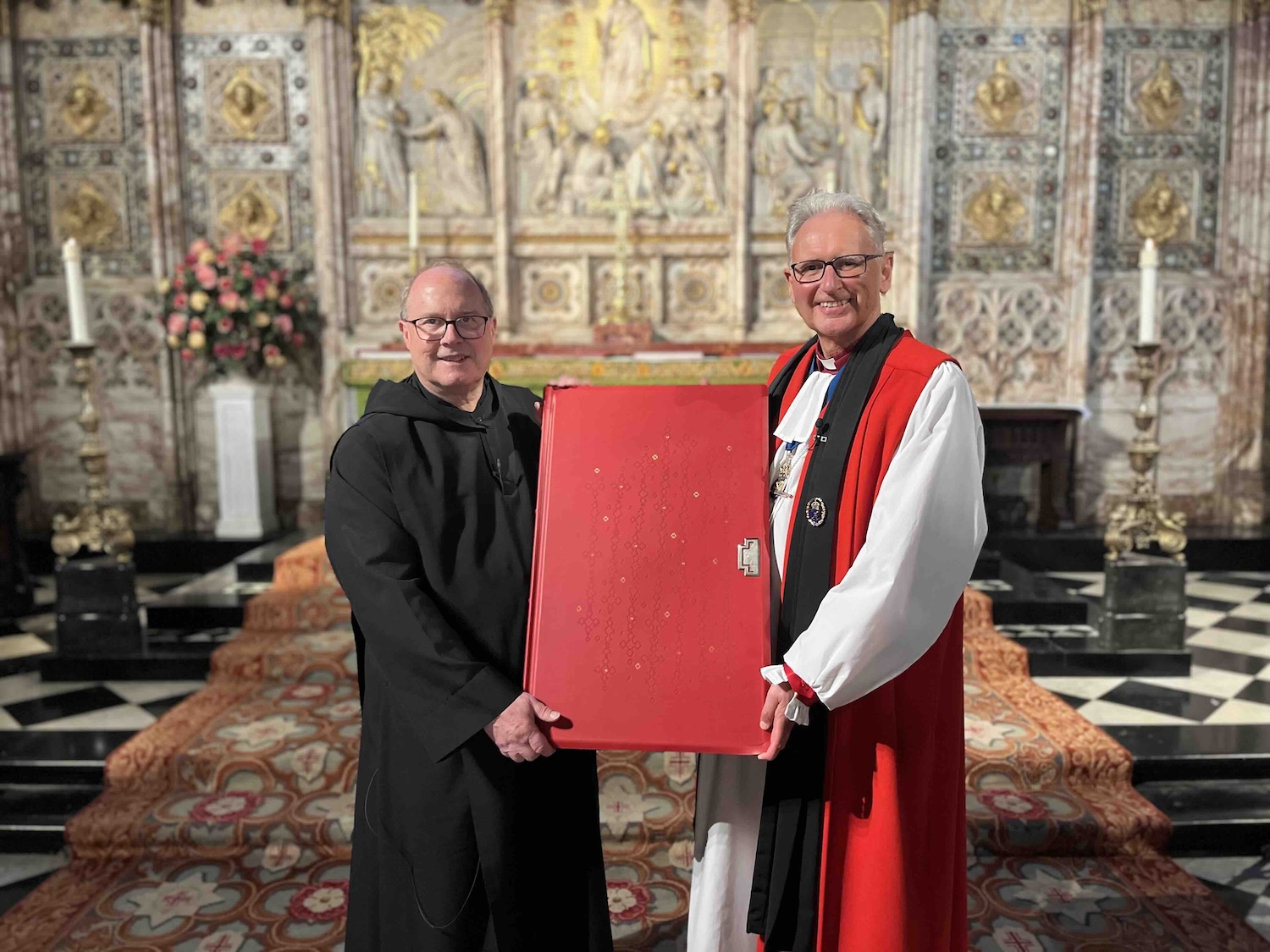
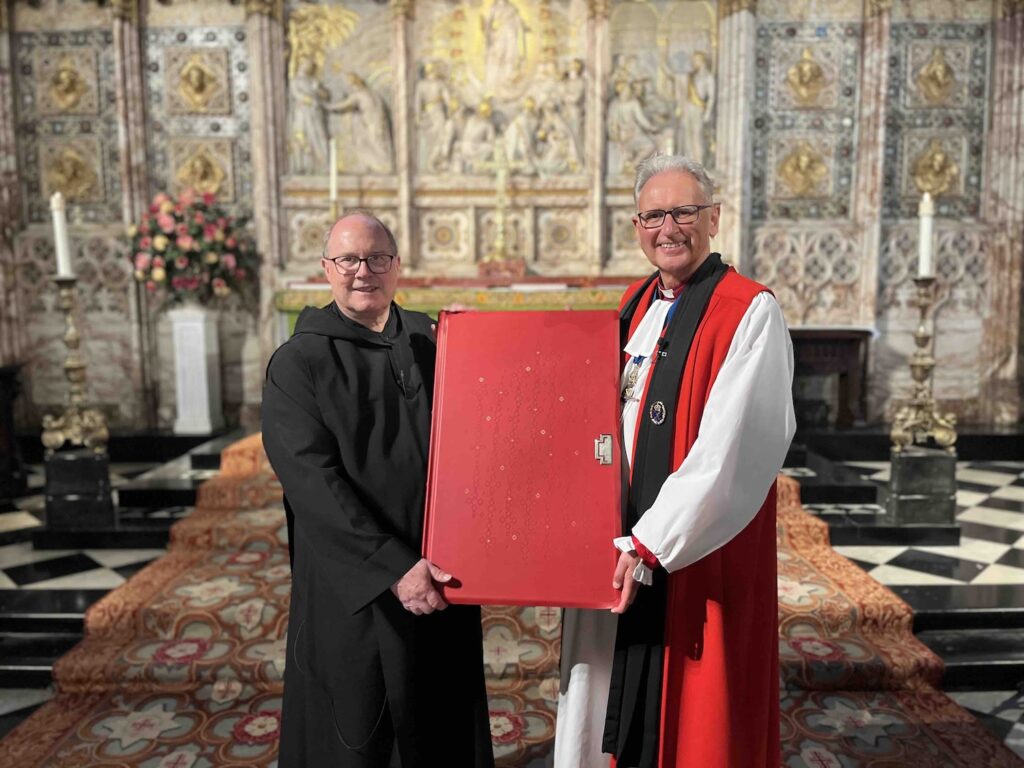
In July of 2025, thirty years after Jackson brought the idea of The Saint John’s Bible to Hollas, a group of generous donors gifted a Heritage Edition to the work to the Order of Malta and dedicated the edition to Hollas. The Heritage Edition will live at St. Ann Catholic Church in Washington, D.C., where the display will be open to the public for endless conversation and collective imagination.
The Saint John’s Bible: Ignite the Spiritual Imagination
To read work by Fr. Eric Hollas, OSB, visit his blog, A Monk’s Chronicle.
To read more articles similar to this one, visit the blog on www.saintjohnsbible.org and subscribe to the e-newsletter, Sharing the Word.